Juz Amma (Suras of Quran)
- 4.9
- Rating
- 1.00M
- Installs
- Free
- Price

 Analysis by App-foxy
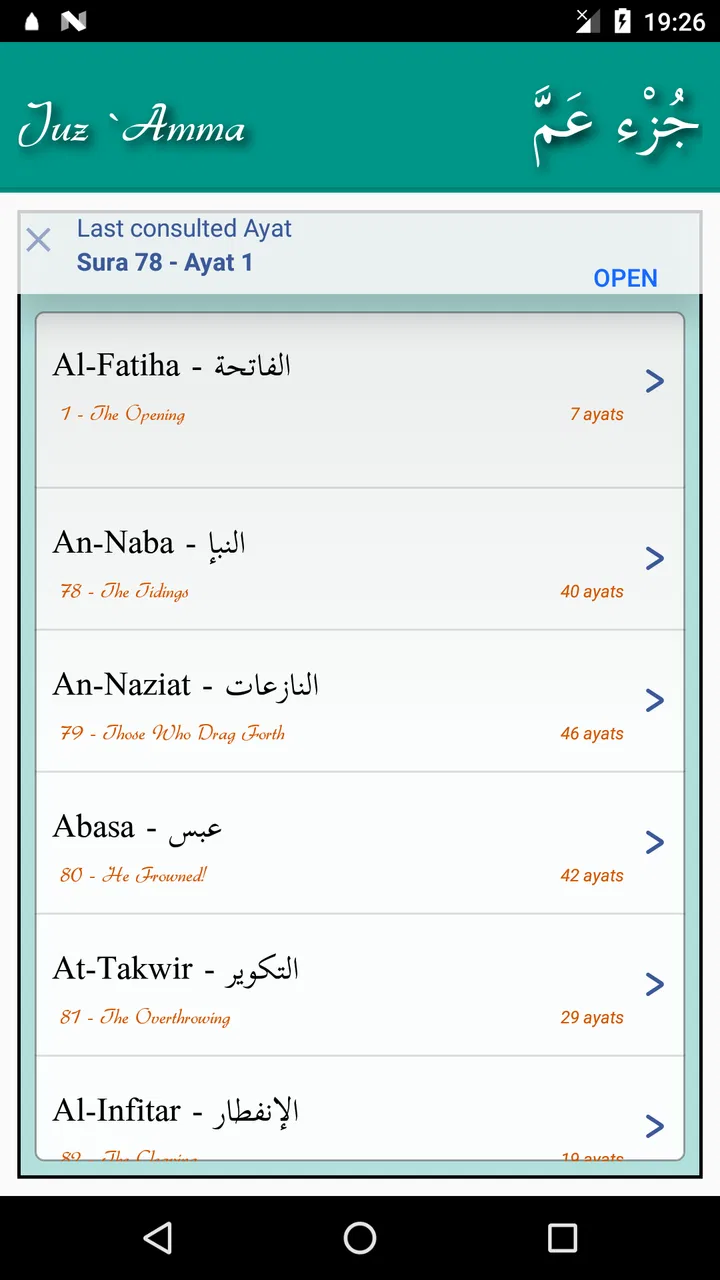
I found Juz Amma (Suras of Quran) most useful when I treated it less like a general reading app and more like a focused companion for revising the shorter chapters of the Noble Quran. Its scope is deliberately narrow: Juz’ Amma, the final section of the Quran, together with Surah Al-Fatiha. That limited approach is also its main strength. Instead of asking me to navigate a huge library, it keeps attention on passages many people regularly recite in prayer, study, memorize, or revisit for reflection.
The app is free, suitable for Everyone, and developed by dimach.cassiope. It belongs to the libraries and demonstration side of Android apps rather than the crowded category of full-featured religious platforms. After its release on February 18, 2012, it built a strong audience, with over a million installs and a 4.9 average from around fifteen thousand ratings. Those figures do not tell me whether it will fit every reader, but they do suggest that its simple purpose has remained useful to many people.
My first impression was that the app makes sense for someone who wants a compact Quran resource rather than an all-in-one study suite. If your immediate goal is to read or revise Juz’ Amma and Al-Fatiha without distractions, the focused library is easy to understand. If you expect translations in many languages, detailed commentary, audio teachers, search across the complete Quran, or a modern learning dashboard, you should approach it with different expectations.
You May Also Like

 Blood Strike: 2.5 Anniversary
Blood Strike’s Loadouts Turn Every Drop Into a Tactical Gamble
A close look at Blood Strike’s custom loadouts: how fast access to signature weapons reshapes its battle royale rhythm, rewards preparation, and narrows the gap between fights.

 Pandora - Music & Podcasts
Pandora’s Music Is Easy to Start, but Harder to Recover
Pandora’s strength is its low-effort path from a seed to a station. Its weak spot is how much confidence it asks you to place in connection, setup, and quiet recovery.

 8 Ball Pool
 Is Built on Rivalries, Rematches, and Routine
A close look at the rivalries, rematches, shared routines, and unanswered safety questions that turn a quick pool match into a persistent mobile community.

 Samsung Music
’s Quiet Strength Is Playing What You Already Own
Its reach comes less from spectacle than from dependable access to a personal library. That simplicity is both the app’s strongest retention engine and its ceiling.

 AccuWeather: Weather Radar
AccuWeather Review: A Quick, Clear Forecast for Everyday Decisions
For everyday plans, the best forecast is the one you can understand quickly. AccuWeather makes rain timing, radar, and local conditions easy to act on, with a few trade-offs.

 Hill Climb Racing
Why Hill Climb Racing Still Turns Crashes Into One More Run
A tiny car, a bumpy hill and one more upgrade: Hill Climb Racing keeps resurfacing because its simple chaos makes every near-miss feel personal.
More From Our News Desk
View All News


Why the first week feels useful
During the first few days, the strongest benefit is clarity. The app’s store short description is simply “Juz Amma,” and that accurately reflects the experience I would recommend it for: opening a small, defined collection and getting straight to the chapters that matter to your current routine. There is less temptation to browse endlessly than in a broad Quran application containing every possible tool.
That makes it particularly practical for a beginner who is building a daily habit. A new learner can choose one short surah, read it repeatedly, and return to the same material without feeling overwhelmed by a large catalogue. Someone who already knows the text can use the same compact structure for revision. I also see value for a person preparing for prayer, because the app’s contents are concentrated around chapters that are commonly learned and revisited.
A useful first-week routine is to keep the app beside your usual Quran or notebook, then use it for a short review session at a consistent time. I would not try to turn the entire section into a single sitting. A better approach is to select a manageable passage, read slowly, close the app, and recite from memory. The app cannot replace disciplined learning, but its narrow scope makes that discipline easier to organize.
Another practical use is checking a familiar passage when I am away from a physical copy. A phone is already something many people carry, so a focused digital collection can be convenient during a commute, a quiet break, or while waiting. That convenience is most valuable when the app opens quickly and the reader already knows what they want to revisit. It is less helpful when the user is looking for broad research or a complete reference work.
For families, the limited selection can also be an advantage. A parent helping a child learn shorter surahs does not need to hand over an enormous application with many unrelated menus. The child can concentrate on the assigned passage. Still, I would keep the teaching itself active: listen to the recitation from a trusted source if needed, correct pronunciation directly, and use the app as a reading aid rather than assuming that a screen alone teaches tajweed.
What makes the focused collection different
Many Quran apps compete by adding everything: translations, tafsir, bookmarks, audio downloads, prayer utilities, reading plans, and social features. That can be valuable, but it also creates friction. Juz Amma takes the opposite route by centering the final chapters and Al-Fatiha. In my view, this is not a weakness for every audience. It is a deliberate trade-off between breadth and concentration.
The first non-obvious advantage is that a smaller collection can support repetition better than a complete library. When the goal is memorization, choice can become a distraction. Having fewer destinations may encourage a reader to stay with one passage long enough to notice recurring words, verse endings, and transitions. I found that more useful than repeatedly opening different sections without a clear plan.
The second advantage is portability of purpose. A full Quran reader may be the better choice for someone following a complete reading schedule, but this app is easier to assign to a specific task: revise short surahs, refresh Al-Fatiha, or keep a compact reference available. That makes it suitable as a secondary app even for people who already use a more comprehensive Quran platform.
The trade-off appears as soon as the task expands. If you want to move from Juz’ Amma to another juz, compare several translations, investigate a word across the whole Quran, or study extensive explanations, this focused app will not be the natural center of your workflow. I would keep a broader Quran application or a trusted physical edition for those needs rather than expecting this one to grow into something it was not designed to be.
How I would build a month-to-month habit
The real test is not whether the app feels pleasant on the first day. It is whether I still have a reason to open it after the novelty disappears. For Juz Amma, that reason comes from recurring practice rather than constant new content. The chapters do not need to change for the app to remain useful; the user’s relationship with them can deepen through repetition, recitation, and reflection.
I would use a three-part cycle. First, read a selected surah directly from the screen. Second, recite it without looking, noting where memory becomes uncertain. Third, return to the text and correct only those weak points. This is more effective than passively scrolling through familiar verses. It also turns a simple reader into a tool for deliberate revision without requiring an elaborate progress system.
For a realistic everyday scenario, imagine a person who has ten quiet minutes after a morning prayer. Rather than opening social media, they choose Al-Fatiha or one short surah, read it carefully, and recite it once from memory. On another day, they review a different passage. Over several weeks, the app becomes a predictable doorway into practice. Its value comes from that repeated action, not from a stream of notifications or novelty.
I would also use it during travel or on days when carrying a physical Quran is inconvenient. In that situation, the app’s compact purpose matters more than advanced customization. A reader can maintain contact with familiar passages even when the normal study environment is unavailable. However, I would avoid making the phone the only part of the routine. Digital reading is convenient, but a balanced practice may include a printed Quran, a teacher, and listening when pronunciation or memorization is the main objective.
There is a subtle benefit in separating reading from measurement. Some modern learning apps encourage streaks, badges, and completion targets. Those systems motivate certain users, but they can also make worship feel like a productivity contest. Juz Amma’s focused character may suit someone who prefers a quieter habit. The downside is that users who need reminders, detailed progress records, or guided lessons may have to create those supports outside the app.
Where long-term maintenance becomes a question
The maintenance burden is low in one important sense: there is not a large course to configure. I do not need to organize a complicated curriculum before reading. The content focus is already established, so the user can decide whether the app belongs in a daily, weekly, or occasional routine. That simplicity helps it earn space on a phone when the goal is straightforward revision.
At the same time, a simple app places more responsibility on me. There may be less guidance than in a dedicated memorization platform, so I need to choose the passage, set the pace, and decide how to check my progress. That is not a problem for an experienced reader, but it can frustrate someone who expects the app to lead every session. The absence of a visible learning path can make the first month feel repetitive if I do not bring my own method.
The free price makes experimentation easy, while optional in-app purchases are listed at $0.99 per item. I would not choose the app because of the possibility of extra purchases; I would first judge whether the core reading experience fits my needs. For a person seeking a focused, low-cost resource, the free entry point is attractive. For someone comparing advanced paid study tools, the important question is not the small purchase amount but whether the desired learning features exist at all.
Because the app is older, I would also approach it with the mindset appropriate for a long-standing utility rather than a constantly evolving platform. That can be reassuring: the central purpose is stable and familiar. It can also mean that users accustomed to polished modern interfaces, frequent design updates, or highly integrated study systems may find the experience less dynamic. I would judge it by dependable access to its intended material, not by whether it matches the newest religious education apps.
One maintenance tip is to keep your personal study plan outside the app. A small notebook or phone note can record which surah you reviewed, which verses need attention, and whether you practiced reading or memorization. This avoids relying on features that may not be central to the application and makes the routine portable if you later switch to a different Quran reader. It also prevents the app from becoming the entire learning system.
What may cause fatigue after the novelty fades
The main source of fatigue is repetition without variation in method. The same collection can be spiritually and educationally valuable, but opening it every day and merely reading from start to finish may eventually feel passive. I would vary the purpose instead: one session for careful reading, another for memorization, another for listening through a separate resource, and another for reflecting on a translation or explanation elsewhere.
A second source of frustration is the boundary of the collection. The app is centered on Juz’ Amma and Al-Fatiha, so a user who begins with short-surah revision may soon want a complete Quran. That is a normal change in needs, not a failure of the app. I would keep this one for its focused role and use a broader alternative when my study expands. Trying to force it into a complete reference tool would create unnecessary disappointment.
Users who need audio-led learning should think carefully before making it their only choice. Reading the Arabic text on a screen is not the same as hearing a qualified reciter or receiving correction from a teacher. For pronunciation, rhythm, and memorization, I would pair the app with an audio source and, where possible, personal instruction. The app can support the visual side of the process, but it should not be treated as a substitute for every other learning method.
There is also a difference between spiritual use and academic research. Someone wanting a calm way to revisit familiar surahs may appreciate the narrow design. A student comparing translations, examining commentary, or searching themes across the entire Quran will probably work more efficiently with a scholarly edition or a comprehensive Quran app. The best alternative depends on the task: Juz Amma for focused revision, a full reader for broad access, and dedicated study resources for deeper analysis.
Another realistic limitation is that a phone can invite interruption. Even a well-chosen Quran app sits on a device associated with messages, browsing, and alerts. I would use a quiet setting, silence notifications, and decide on the passage before opening the app. That small preparation matters because the app’s simplicity cannot control the distractions surrounding it.
Who should keep it installed
I would recommend keeping Juz Amma on an Android phone if your recurring needs are specific: revising shorter surahs, reading Al-Fatiha, supporting a child’s early practice, or maintaining a compact Quran reference for travel. It is especially appealing to readers who prefer a focused tool over a crowded dashboard. The strong average rating and large install base make it easy to see why the straightforward concept has connected with many users, although personal fit remains more important than popularity.
I would be more cautious about recommending it as a single Quran app for someone beginning a broad study journey. If you want the complete Quran, extensive translation choices, searchable commentary, structured memorization plans, or rich audio controls, choose a platform built around those functions. This app can sit beside that tool, but it is unlikely to replace it for a demanding long-term curriculum.
It is also not the ideal choice for someone who needs external accountability. Without a personal plan, a teacher, or another tracking method, the app may become something I open only when I happen to remember it. Its quiet design suits self-directed readers, while users who depend on reminders and visible milestones may find a learning-focused alternative more motivating.
For older family members or children, I would test the reading comfort personally before settling into a routine. The usefulness of a text app depends on whether the display, navigation, and reading flow feel comfortable to the individual. A parent should also supervise the learning process when pronunciation matters, because correct recitation cannot be judged solely by looking at the written text.
My long-term verdict
After the first-week appeal fades, Juz Amma earns its place through repetition, not expansion. It does not need a new feature every month to remain relevant to someone who regularly revises the final chapters of the Quran. Its lasting value is the same reason I would recommend a small, well-chosen notebook: it keeps one important task close at hand and removes excuses caused by excess choice.
My honest view is that the app works best as a focused companion, not as a universal Quran solution. The free access lowers the barrier to trying it, the Everyone rating makes it broadly approachable, and the concentrated collection gives it a clear identity. The optional $0.99-per-item purchases are a minor consideration, but the larger decision is whether its limited scope matches your practice.
The app earns lasting space when your habit is specific enough to benefit from focus. Use it for deliberate reading, memorization review, and regular contact with Juz’ Amma and Al-Fatiha. Pair it with a teacher, audio recitation, printed text, or a more complete study app when your needs go beyond that role. If you accept that boundary, I think it remains a useful and refreshingly uncomplicated resource long after the initial download.
In the end, I would recommend it to a friend who asked for a compact way to revisit these surahs without being pulled into a large collection of unrelated tools. I would not recommend it to someone seeking a complete research library or a guided learning course. That distinction is important, because the app’s greatest strength and its clearest limitation are the same thing: it stays centered on Juz’ Amma and Surah Al-Fatiha.
FAQs for Juz Amma (Suras of Quran)
01What is Juz Amma and what does this app offer?
Juz Amma refers to the 30th and final section of the Quran, which contains shorter suras that are often memorized and recited by Muslims. The Juz Amma app offers an easy-to-use platform for users to read, listen, and learn these suras. It typically includes features like audio recitations, translations, and tafsir (exegesis).
02Is the Juz Amma app suitable for beginners?
Yes, the Juz Amma app is designed to cater to both beginners and advanced learners. It usually includes features like transliterations and translations in multiple languages, making it accessible for users who are new to Quranic studies. Beginners can start with short suras and gradually progress with the app's guided resources.
03What audio features are available in the Juz Amma app?
The Juz Amma app typically includes high-quality audio recitations by renowned Quran reciters. Users can listen to suras individually or continuously, with options to repeat verses for better memorization. The app often offers recitation speed control and the ability to download audio for offline listening.
04Does the app provide translations and tafsir?
Yes, most Juz Amma apps offer translations in multiple languages to aid understanding. Additionally, they often feature tafsir (interpretation) of the suras to provide deeper insights into the meanings and context. This makes the app a valuable resource for both language learners and those studying Islamic teachings.
05Is the Juz Amma app available for both Android and iOS?
The Juz Amma app is generally available for both Android and iOS platforms. Users can download it from the Google Play Store or the Apple App Store, ensuring compatibility with a wide range of devices. Be sure to check the app's specifications and user reviews for the best experience on your device.
Pros
- User-friendly interface for easy navigation.
- Audio recitation available for all Suras.
- Supports multiple languages for translation.
- Bookmark feature for quick access to Suras.
- Adjustable font sizes for better readability.
Cons
- Requires internet connection for audio.
- Limited customization options available.
- No offline mode for translations.
- Ads can be distracting at times.
- No dark mode for night reading.

Juz Amma (Suras of Quran)
Gallery